VOYAGER 1 + VOYAGER 2
Humanity's Interstellar Messengers
Where Are They Now?
Scroll to explore the live tracker
LIVE DEEP SPACE TRACKER
Positions are calculated estimates projected from the latest official NASA data. See Methodology.
COSMIC ODOMETERS
Distance from Earth, updated live from an official NASA baseline + calculated velocity — not raw NASA telemetry.
WHO IS FARTHER?
DISTANCE BETWEEN VOYAGERS
Straight-line distance between the two spacecraft, from a simplified 3D geometric model (not a precision ephemeris).
WHERE ARE THEY?
An educational companion to NASA's official 3D tools — not a replacement for them.
Logarithmic visualization — distances compressed for legibility, not to true linear scale.
Explore NASA Eyes on the Solar System →THEIR JOURNEYS ARE DIFFERENT
Voyager 1 Trajectory
- Earth
- Jupiter
- Saturn
- Interstellar Space — Since 2012
Voyager 2 Trajectory
- Earth
- Jupiter
- Saturn
- Uranus
- Neptune
- Interstellar Space — Since 2018
VOYAGER 1 vs VOYAGER 2
| VOYAGER 1 | VOYAGER 2 |
|---|
VOYAGER TIMELINE
SIGNAL DELAY
signalDelay = distance ÷ speed of light
This is only the light-travel time. It is not a guarantee of actual Deep Space Network processing or scheduling delay.
DEEP SPACE NETWORK
NASA communicates with both Voyagers via the Deep Space Network (DSN).
VOYAGER → DEEP SPACE → EARTH → DSN
SCIENCE INSTRUMENTS
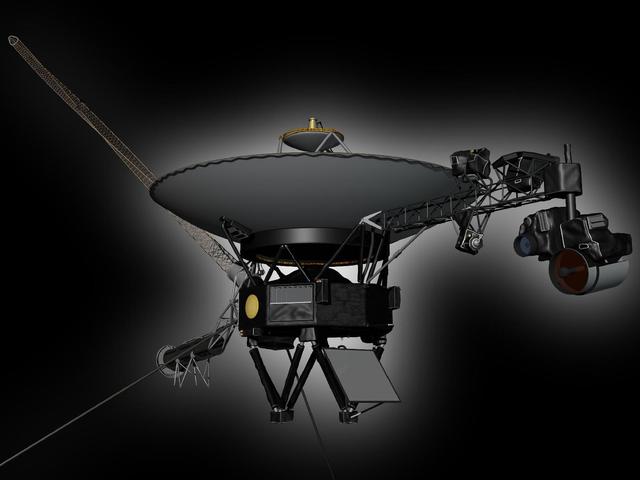
The Voyager twins originally carried 11 science instruments each. Status below reflects the latest official NASA information — not assumed.
POWER SYSTEM
Each spacecraft is powered by Radioisotope Thermoelectric Generators (RTGs), which convert heat from decaying plutonium-238 into electricity.
Combined RTG output declines by about 4 watts per year, requiring the mission team to progressively power down instruments.
MISSION STATUS
MISSION UPDATES
Latest official NASA updates about the Voyager mission.
THE GOLDEN RECORD
PALE BLUE DOT
VOYAGER GALLERY
DATA & METHODOLOGY
Official
—
Calculated
—
Estimated
—
Historical
—
estimatedDistance = baseDistance + (escapeRateAUyr × AU_KM) × elapsedYears
When official data is unavailable
—
DATA SOURCES
Primary Source — NASA
Supplementary Reference — Wikipedia
NASA is the primary and authoritative source for all mission data on this site.
Our visualization is an educational companion to NASA's official resources, not a replacement.